Windy Arbor Primary School

Early Years

Early Years Foundation Stage
Intent
At Windy Arbor, in our Early Years Foundation Stage, our intent is to provide a broad, balanced and flexible curriculum that addresses the children’s social, emotional, physical, moral, spiritual and cultural development.
Encompassed within our vision, “to equip and empower every child so that they can make a positive contribution to society and be the best version of themselves” is the need for every child to be exposed to a range of experiences where doors are opened to dream, believe and achieve.
Every child is unique and we pride ourselves on listening to children and those who care for them, using this information to personalise each child’s learning. Staff observe and recognise children’s interests and are confident in being flexible to adapt the curriculum ‘in the moment’ to ensure interests are developed further.
We strongly believe in first-hand learning experiences and valuing the importance of the outdoor environment to develop and support children’s thinking and problem-solving skills. We provide children with a safe and stimulating environment, support and encouragement to enhance internal motivation and independence
We strive to build positive partnerships with Parents/Carers and other practitioners linked to supporting children in our Early Years.
Implementation
To implement our EYFS curriculum we begin each new year by considering the individual needs of our children and their different starting points to develop our flexible curriculum which enables them to follow the path of their learning journey, at a point, that is suitable for their unique needs and stage of development.
To support transition, we provide a range of opportunities.
- Parent/Carer Welcome Evenings
- Previous setting visits
- Transition meetings - staff from previous settings/wider outside agencies
- Parent and Child Pre-Visits to School
- Stay and Play Sessions
- Parent Questionnaires
We follow the EYFS statutory framework 2025 and Early Years Foundation Stage Profile Handbook 2025. Alongside this, we use the supporting documents e.g: Birth to Five, Development Matters Outcomes and the Assessment and Reporting Arrangements.
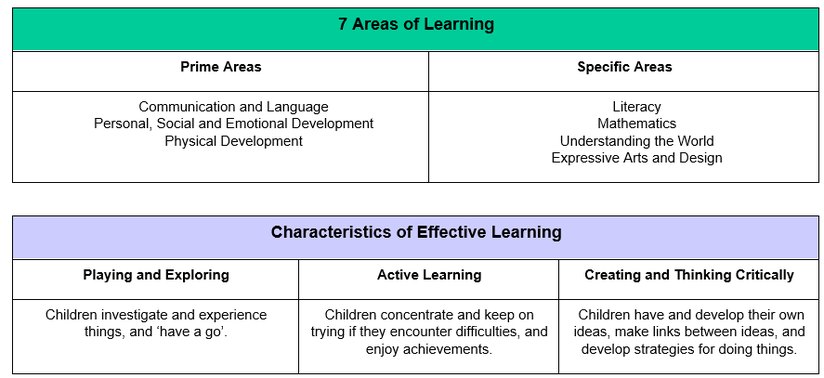
Within the Early Years curriculum, there are 7 areas of learning which, in partnership with parents, we will monitor and nurture.
The areas of learning and development are inter-connected and equally valuable; however, the three prime areas are particularly important for igniting children’s curiosity and enthusiasm for learning, forming relationships and thriving within the environment.
Staff plan a broad range of activities and experiences that enables children to develop and learn effectively. The curriculum is delivered with a balance of small and large group adult-led teaching sessions and time and space for children to lead their own learning through child-initiated activities. During children’s play, staff observe and interact to stretch and challenge further.
- We support and encourage children to develop a life-long ‘love’ of reading by using ‘stories’ as a hook to ignite interest, as well as shared reading, daily phonics and reading practice sessions to build decoding, prosody, comprehension and writing skills.
- Daily maths sessions support children to ‘have a go’ and develop a strong knowledge of numbers and the relationships between them, using a wide range of concrete resources. Through adult metacognitive talk, children gain the reasoning and language skills to interpret and discuss their thoughts, understanding and problem-solving skills.
- During Jigsaw sessions and beyond, we nurture children to be confident, healthy and happy and provide opportunities to develop their emotional intelligence and life skills. We encourage children to talk about and understand their own feelings and that of others, using bucket numbers, each day. Staff monitor our buckets and support children where necessary.
- Forest School sessions provide a practical way to learn outdoors whilst developing a deep understanding of their natural world, working as part of a team and solving problems.
- Wonderful Workshops and Flourishing Future Days encourage the development of ‘essential skills’ and inspire children to become:
Happy Historians
Super Scientists
Great Geographers
Amazing Artists
Marvellous Musicians
Brilliant Bakers
- Children in Reception are set weekly phonics/maths homework to consolidate learning. ‘How to’ videos are uploaded onto our class webpage and Dojo to provide guidance for parents to enable them to support their children to embed concepts and skills.
- We recognise when children have ‘had a go’, ‘tried their best’, ‘met their target, ‘displayed a specific skill’ or has ‘good attendance’ and celebrate achievements by saying ‘well done’ and awarding them with stickers, dojos, gold prizes, certificates badges or a nomination for the weekly headteacher’s award.
Where a child may have a special educational need or disability, we liaise with our School SENCo and, relevant services from other agencies, where appropriate. Staff follow guidance that has been offered to support a child/ children. We also provide intervention where appropriate, for example speech and language, physical activities and ‘keep up’ sessions. Our school inclusion team provide support with behaviour and nurture and where necessary, further guidance from outside agencies is sought.
We recognise that children learn and develop well when there is a strong partnership between practitioners and Parents/Carers. Parents/Carers are kept up to date with their child’s progress and development to provide a well-rounded picture of their child’s knowledge, understanding and abilities. We do this through:
- Parent Consultations
- SEN Reviews
- Parent Curriculum Workshops
- Share a Story Time
- Weekly News Letter
- Class Webpage - outlining weekly and termly learning opportunities and ‘how to’ videos to support
- Class Dojo
- Daily Conversations
Impact
Observation, assessment and evaluation are planned for and used throughout the year to inform planning that will allow the children to succeed in their next steps of learning, and ensure that each child's differing needs are met. Assessment is based around ongoing observation and the recording of progress towards the 17 Early Learning Goals.
Staff meet on a weekly basis to plan alongside their medium-term plans and current observations, which remains flexible for unplanned circumstances or children’s responses. It is through this process that children will work towards achieving The Early Learning Goal; the level of development expected at the end of the EYFS.
Quality and consistency in teaching and learning to enable every child to make good or better progress.
Assessment opportunities include:
- Information is gathered from the previous setting or previous teacher
- Parent Questionnaires
- Reception Baseline Assessment
- All observations, assessments and recording are an integral part of teaching, as they inform future planning for children's needs and development;
- Observation carried out whilst children are engaged in child- initiated activity/play, in order to gain an insight into children's level of understanding related to specific skills and concepts;
- Observations carried out during adult-led group work/whole class teaching in order to assess children's level of understanding related to specific skills and concepts;
- Discussions with staff and children about their interests and their learning;
- Exchange of information with parents at parent consultation meetings;
- Pupil progress meetings with the Senior Leadership Team; Early Years Leader;
- The Early Years Leader works with other leaders and the Year 1 teachers to assist transition and planning for each child; Participation in moderation internally and with collaborative groups as appropriate. (UNITY)
The teacher keeps progress records on our school-based assessment system INSIGHT, observations and records examples of each child’s work. These contain a wide range of evidence that we share with parents at each parental consultation meeting.
Insight is updated at the end of each term. This provides a summary for each child as to their progress towards meeting the Early Learning Goals. This feeds into the School EYFS assessment and tracking process. We record each child’s level of development to be not/ on track and initiate support and intervention where appropriate. It is through these processes that children will work towards achieving expected; the level of development expected at the end of the EYFS.
The child’s next teacher uses this information and shared discussions during an end of year transition meeting to make plans for the year ahead.
We share this information at parental consultation meetings and in the end-of-year report. Parents receive an annual written report that offers comments on each child’s progress in each area of learning. It highlights the child’s strengths and development needs, and gives details of the child’s general progress and their characteristics of learning.